

Adire is a traditional textile craft originating from the Yoruba people of Nigeria, particularly in the southwestern region. The word “Adire” translates to “tie and dye” in English, reflecting the technique used to create the distinctive patterns on the fabric. It became prominent in the 19th century, with women using indigo dye to create intricate designs on cotton cloth using various resist-dyeing techniques such as tying, stitching, folding, and binding. Adire textiles were originally made for personal use, including clothing and home decor, but eventually became a significant part of Yoruba cultural identity and an important economic activity. Today, Adire continues to be celebrated for its rich cultural heritage and artistic expression, with contemporary designers incorporating traditional motifs into modern fashion and design.
Origin and place Adire started
Adire originated among the Yoruba people of southwestern Nigeria, particularly in towns like Abeokuta, Ibadan, and Osogbo. The craft has a long history dating back to the 19th century. Women in Yoruba communities, especially those in Abeokuta, are credited with the development and popularization of Adire textiles. The town of Abeokuta, in particular, became renowned for its skilled artisans and vibrant Adire market. Over time, Adire spread to other Yoruba communities and beyond, becoming not only a cherished cultural tradition but also an important economic activity. Today, Adire remains deeply rooted in Yoruba heritage and continues to be produced and celebrated both locally and internationally.
Significance of the patterns by the Natives
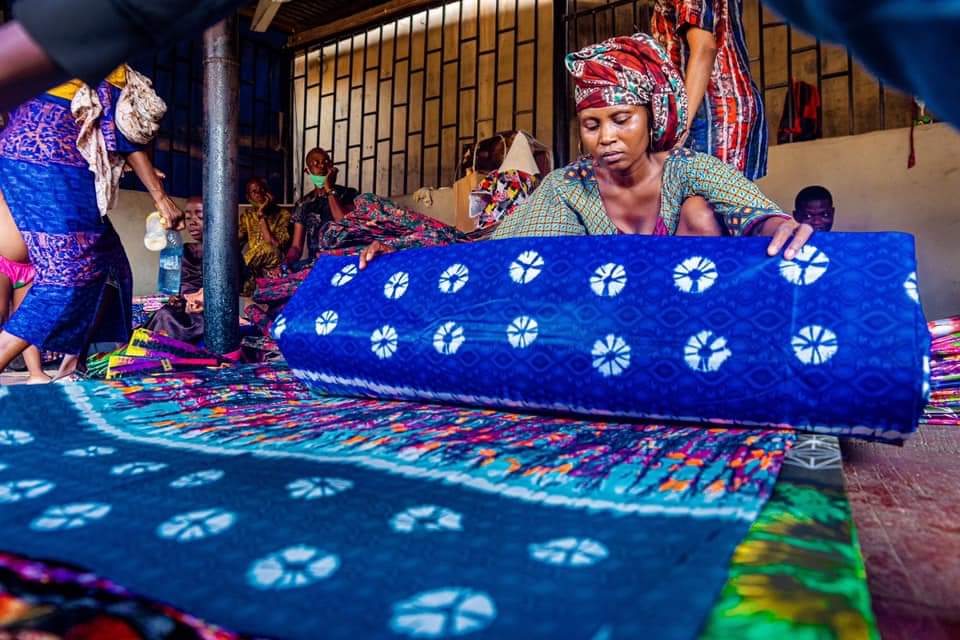
The patterns found in Adire textiles are inspired by various sources, including Yoruba cultural motifs, symbols, and cosmology. Some of the traditional patterns commonly found in Adire include:
1. ”Ona” or “Alabere”: These are simple striped patterns often created using the “tie and dye” technique, where sections of the fabric are tied off before dyeing to create a resist effect.
2. ”Olokun”: This pattern represents the waves of the ocean or river, symbolizing the deity Olokun, who is associated with wealth and the depths of the sea.
3. ”Eleso”: This is a motif featuring circles or dots arranged in a grid-like pattern, symbolizing fertility and continuity.
4. ”Eleko”: Characterized by intricate geometric designs, often featuring squares, diamonds, or triangles, representing the interconnectedness of life and the cosmos.
5. ”Iroke”: This pattern consists of concentric circles radiating from a central point, symbolizing the cyclical nature of life and the universe.
These patterns, along with others, carry deep cultural significance and are often imbued with symbolic meanings related to spirituality, social status, and personal identity within Yoruba society. While traditional patterns are still prevalent, contemporary designers also experiment with new motifs and color combinations, blending traditional techniques with modern aesthetics.
